The problem behind it
On 28 October I rejected a batch of AI drafts for Mukika with a blunt note: this is not how I speak, this is very AI. I asked for a tool that could turn a sentence into a particular voice, not just a pile of rules about tone.
There was a second problem. My client-facing voice is more professional than the way I talk to my team. So the "voice" could not be one hard-coded thing. It had to be data I could change at any time, kept for each client.
What the tool does today
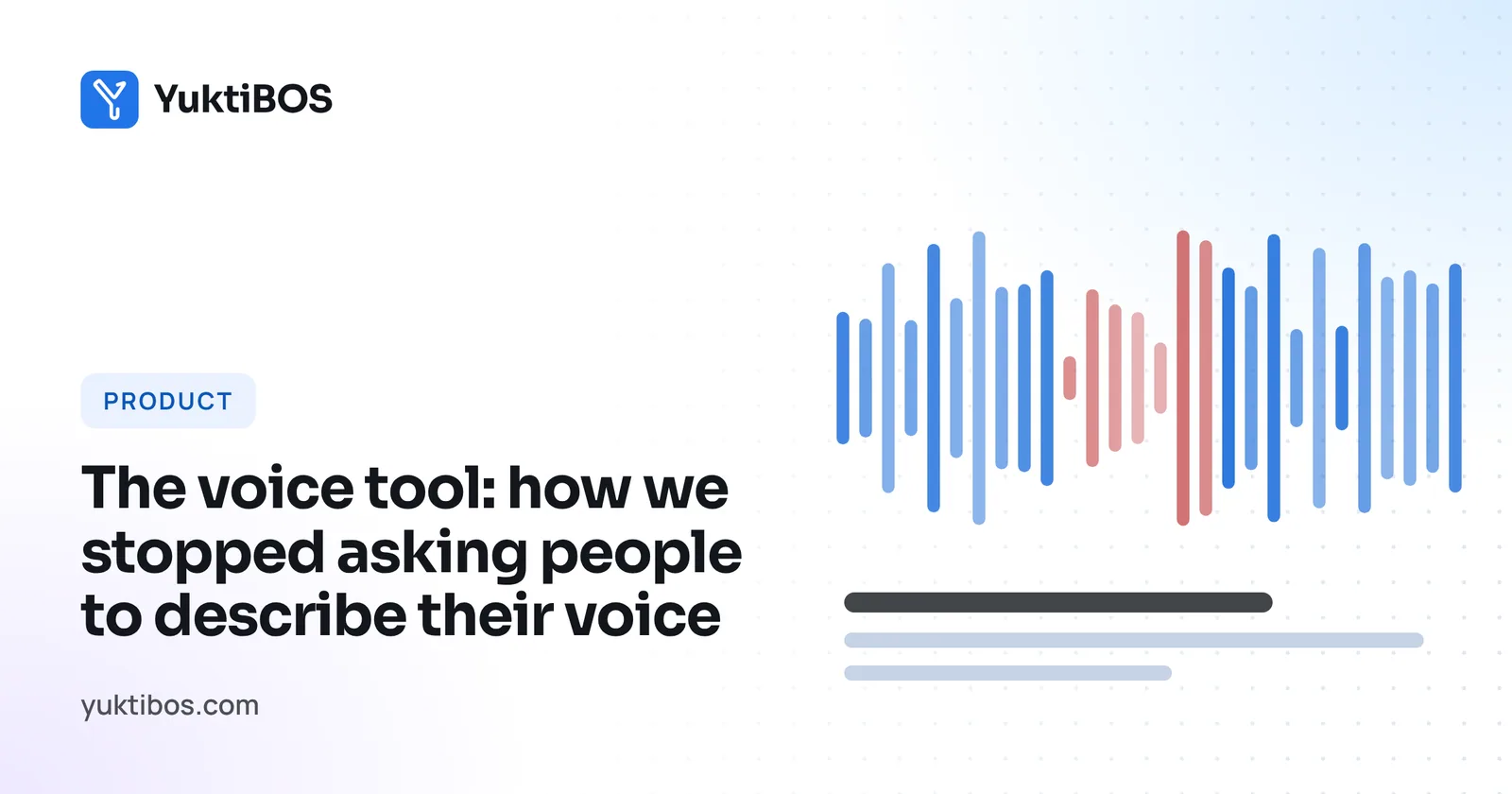
The tool is called the Voice and tone finder. It builds a "voice and tone system", which I think of as a design system for words. The flow, from the help article:
- Gather. Talk to Yukti: it asks one question at a time, by voice or typing, and any question can be skipped. You can also paste or upload text, give a website or YouTube link, and name inspirations.
- Find. Choose the channels the voice is for. Take an optional quiz. Pick which sample sounds like you. Then Yukti proposes the voice.
- Shape and test. You get a finished document, not a form. Then you test it on a real piece.
- Approve. Approving builds the short brand card that writers and checkers read.
Every save is a new version. Only an approved version is used by writers. A voice check in plain code flags things like em dashes, "Let's dive in" and sentences over 25 words. A "Make it sound like us" rewrite is only ever a suggestion that a person accepts or ignores. If a rewrite adds a number that was not in the draft, code throws it away.
Later additions: three voices per client (brand, founder, mascot), each with its own approval; an on-voice score from 0 to 100; "rewrite my copy in this voice"; and customer language mined from the client's own sources, kept only if the phrase appears word for word.
The decisions that mattered
1. We watched what I did, not what I said. On 30 October I walked the first version and the notes from that session say where it lost me. I froze at writing answers but talked freely. I could not pick personality words ("it is like getting a tattoo"), but I picked between two versions instantly. I fixed a sentence the moment I saw a draft. So the tool now leads with a spoken interview and a "pick the one that sounds like you" step, and treats picks and edits as stronger signals than stated answers.
2. Give, don't ask. The principle I wrote on 31 October: if the tool had asked me for each component of a design system, I would have said don't create them. Promise less, give more. So most of the "shape" step stopped being a form. The tool drafts every part and shows a finished document. People edit in place.
3. Speech is for ideas, not for style. Each source is tagged Ideas, Style or Both. A spoken interview defaults to Ideas. Habits drawn from my spoken answers made the brand sound like my speech instead of the crafted site copy. Code now removes any "after" example copied from speech. Raw speech never becomes a brand example.
4. A quiz that adapts, like the GMAT. The first quiz was 12 to 16 yes or no lines. I suggested the adaptive idea: each scale starts in the middle, a yes goes further, a no goes back, and it stops where the answer flips. It usually takes three or four lines per scale.
5. Rules are "letter and spirit". Most things are not hard bans. Words have a strength: never, rarely, sometimes, freely, prefer. Checklist items are always, usually or sometimes. Always checks become must-pass rules in the scored review.
6. Code picks the options. In the "pick the one that sounds like you" rounds, code decides the four slider settings. The model only writes the text. When we let a model choose, the options were nearly identical.
What went wrong
- The shell's forward button was wiped on first load because React runs a child's effect before its parent's. The Brand finder had a dead end for that reason on 31 October, and the voice shell had the same latent bug.
- A saved section jumped back to section 1.
- Pasting whole articles and video transcripts was hard.
- A double click answered two quiz lines at once. Now a second press within 0.6 seconds is ignored.
What's next
From the handoff list: a competitor voice map, a customer quiz link, a PDF or deck or prompt pack, a "you say Y" comparison, reviews from a URL, and a selling page. I have not decided pricing. These are listed, not built.
Numbers at a glance
| Item | Value |
|---|---|
| Steps in the tool | 5 (Gather, Find, Shape, Test, Approve) |
| Original quiz length | 12 to 16 lines |
| Adaptive quiz | usually 3 or 4 lines per scale |
| Voices per client | 3 (brand, founder, mascot) |
| On-voice score scale | 0 to 100 |
| Typical rewrite cost (2,000 characters, worst-case estimate) | about Rs 1.70 |
| Score cost / cost to mine customer words | about Rs 0.05 / about Rs 0.14 |
| Per-use cost cap | Rs 5 by default |
Voice and tone is a free tool: stop describing your voice. show it, and get a guide back.
Open Voice and toneWe are onboarding a small number of businesses for early access, and we read every feature request.